NAMS Nepal presentations 2018 (R Martin)

Here are the four presentations given to National Academy of Medical Sciences, Bir Hospital Pathology and Medicine Residents over the week commencing 7/5/18  by Emeritus Professor Robert Martin, President of the Diagnostic Microbiology Development Program.


Elements of laboratory QMS (WHO)

References


Posted in Med Micro topics-advanced, Nepal, Pathology, Quality management | Tagged , | Leave a comment

NAMS Nepal presentations 2018 (JK Ferguson)

Here are the three presentations given to National Academy of Medical Sciences, Bir Hospital Medical Residents over the week commencing 7/5/18. Thank you for attending and I hope they were useful. Please feel free to contact me via email if you have questions!  As mentioned, I do encourage you to enrol in the international online AMS MOOC course.    Best wishes, John

References

Posted in A/m stewardship, Module-basic microbiology and AMR, Module-Respiratory infections, Nepal | Tagged , | Leave a comment

How to read the cumulative antibiogram and its usefulness

Here are example antibiograms for Hunter New England (NSW). These are constructed by assessing the % susceptible for specific bugs and drugs, taking only the first isolate of a species per person per annum.  Where is it possible extrapolate susceptibility rather than test or we know a particular species is intrinsically susceptible, we enter “S”. Conversely, species that are intrinsically resistant to an antibiotic (e.g. Gram negatives and vancomycin) are marked as “R”.  In either situation, there is no rationale for actually testing that antibiotic against the species.

Continue reading

Posted in Antimicrobial susceptibility testing, Med Micro topics-advanced | Tagged , | Leave a comment

Nocardia and aerobic actinomycetes

Guest posting: Dr Syeda Navqi, Microbiology Registrar, Pathology North. 

Group: Aerobic actinomycetes

  • Gram positive bacteria that are usually filamentous and branched, commonly producing a fungus like mycelium that fragments into rod shaped or short coccoid form.
  • All grow better under aerobic than anaerobic conditions, a feature distinguishing them from most organisms in the genus Actinomyces.
  • The organisms containing mycolic acids in their cell walls (included in the genera Nocardia, Rhodococcus, Gordonia, Tsukamurella, and Corynebacterium) are rather closely related on the basis of molecular genetic studies.  c.f. Streptomyces, Actinomadura, Dermatophilus have no mycolic acid.
  • Nocardia is the most important genus as the most commonly isolated aerobic-actinomycete human pathogens.
  • There are approximately 87 validly named species included in Nocardia genus.

Identification

Continue reading

Posted in Bacteria (GPOS), Med Micro topics-advanced, Module-Respiratory infections | Tagged | Leave a comment

Recent update on TB diagnostic techniques – GenXpert MTB/RIF Ultra

Guest posting: Dr Ian Marr, Microbiology Registrar, Pathology NSW, Hunter

The GenXpert used in most LMIC has cartridges for detection of Mycobacterium tuberculosis (MTB) – GenXpert MTB/RIF. These contain primers and molecular beacon probes for the detection of both MTB and its resistance to the first line drug rifampicin. By looking for mutations in the rpoB gene (transcribes for RNA polymerase) it can determine if rifampicin (which inhibits RNA polymerase) will work and also if MTB is present. Continue reading

Posted in Module- Mycobacteria | Tagged , | Leave a comment

AST, MIC, Clinical Breakpoints, ECOFFs and AST QC

Please remember to revise this page for the detailed explanations about AST, MICs, Breakpoints, ECOFFs etc.  A summary of relevant concepts is here – Antimicrobial susceptibility testing practical approaches to quality control Nov 2016.

Some questions that arose in today’s tutorial- 

1. Is the ECOFF the same as the Clinical Breakpoint MIC? 

Not infrequently – for instance, clinical breakpoints are not established for tuberculosis drugs and the ECOFF is used as the breakpoint. And so the isolates with MICs above the ECOFF are assumed to be resistant. However that may not actually be the case- higher dosing may enable higher drug levels and clinical effectiveness.
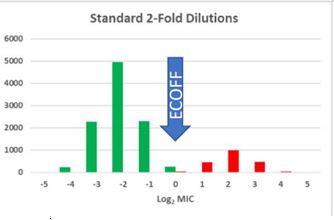
Here we have a nice separation of wildtype (green) and non -WT (red) isolates with an ECOFF (at the upper limit of the WT distribution) that separates the two well.  When clinical breakpoint setting takes place, the first issue that is taken into account is the ECOFF – the clinical breakpoint must not be set to a value that lies within the WT distribution. If it is, then the same WT isolate may test resistant or susceptible on successive tests due to the inherent variability of testing.

2.  Can an ECOFF be always discerned from the MIC distribution? 

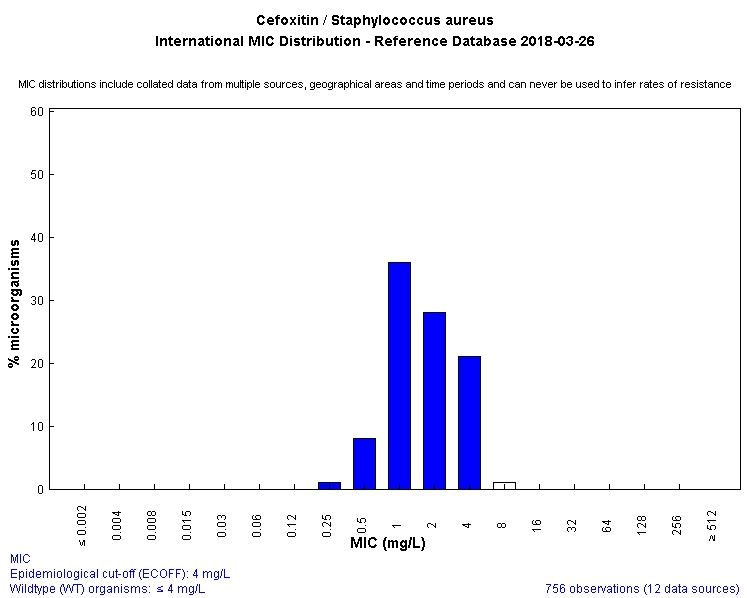
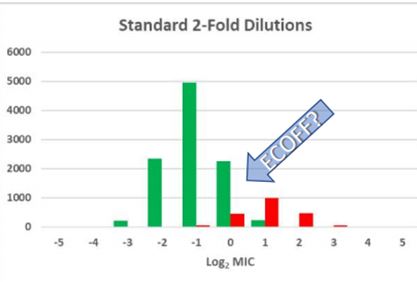
No- take a look at this distribution- the nonWT (red) isolates have a different MIC distribution but this overlaps the WT distribution. There is no MIC value that will separate the two populations. In this circumstance ,  provided the clinical breakpoint can be set above both distributions (i.e. achievable drug levels and PD parameters can be satisfied for isolates 2 or below) then there is no problem.   Or perhaps a different antibiotic will allow the separation of WT and Non-WT – a good example is MRSA detection  – the MIC distributions of MRSA and MSSA overlap when tested against oxacillin. When tested against cefoxitin, they dont overlap. See the following two graphics – WT is blue.
3. What quality control is necessary for AST? What are possible reasons for smaller or larger zones than expected when testing control organisms? How should one handle the control (ATCC) strains to ensure that they work properly? 

Fiona’s presentations take you through what you need to know – please review them via here.

4. We discussed the three antimicrobial agents for this module – flucloxacillin, amoxycillin/clavulanate and cotrimoxazole (bactrim) which you need to systematically study.  I asked whether Strep. pyogenes is ‘susceptible’ to cotrimoxazole (SXT)?  

This recent paper provides one answer – S. pyogenes‘ in vitro susceptibility to SXT depends on the medium’s thymidine content and provided that is controlled, nearly all isolates are susceptible.  There was a subsequent letter and reply which challenged the presumption that thymidine content in tissue may be sufficient to render SXT resistant in practice; however that is an issue that cannot be decided yet.

SXT remains useful for MSSA and MRSA treatment – the 2016 PMGH antibiogram showed 96% and 91% susceptibility for MSSA and MRSA respectively. Gram negative susceptibility unfortunately very low now.

This graphic about emergence of resistance in Staph. aureus is useful – Staph aureus resistance. 

Please contact me with any other questions re this important topic. I will post a separate posting with questions on interpreting the cumulative antibiogram later this week.  John

Posted in Module-basic microbiology and AMR | Tagged , , | Leave a comment

Module 1 2018 – additional short answer questions

  1. Contrast the terms phenotype versus genotype and give several examples related to antibiotic resistance in Staph. aureus and Coliforms.
  2. What does MLST stand for and how is it determined?
  3. What are disadvantages of using resistance genotype compared with a phenotype?
  4. Contrast the terms pharmacokinetics and pharmacodynamics when applied to antibiotics and their action against microorganisms.
  5. What does phylogeny mean?

References/reading

  • New tree of life (Nature Microbiology 2012) – the phylogeny of life as shown by whole genome sequencing
  • Microbiome review (BMJ 2017) – i will email you the pdf.
  • WHO AMR Fact Sheet (Jan 2018)
Posted in Module-basic microbiology and AMR | Leave a comment

Human Papilloma Virus key papers: testing strategy, impact of immunisation, women’s knowledge (PNG)

HPV and cervical cancer remain incredibly important topics for detailed study by all post graduates.  Again, these papers are available as free text via the PUBMED links provided.

  • Field Evaluation of Xpert HPV Point-of-Care Test for Detection of Human Papillomavirus Infection by Use of Self-Collected Vaginal and Clinician-Collected Cervical Specimens. J Clin Microbiol. 2016 Jul;54(7):1734-7.  Toliman P et al.

An important paper to review: “Self-collected vaginal specimens had excellent agreement with clinician-collected cervical specimens for the detection of hrHPV infection using the Xpert HPV test. ”   

[In other unpublished research from PNGIMR and Burnet Institute, abnormal acetic acid colposcopy-directed POC Xpert HPV testing was effective at enabling a same day cryotherapy approach to deal with HPV positive cervicopathology. 

  • Human papillomavirus vaccination: the population impact. Lee LY, Garland SM. F1000Res. 2017 Jun 12;6:866.An essential read – free full text and reasonably short. Provides an overview of all the HPV immunisation and its impact as a prophylactic measure, contrasting available data from around the world.

“This mini-review focuses on the need for HPV vaccine implementation in Asia given the substantial disease burden and underuse of HPV vaccines in LMICs in this region. In addition, the progress towards HPV vaccine introduction, and barriers preventing further rollout of these essential, life-saving vaccines are also discussed in this article.”

  • Ambiguous bodies, uncertain diseases: knowledge of cervical cancer in Papua New Guinea. Ethn Health. 2017 Feb 3:1-23. Kelly-Hanku A et al.
Very important qualitative research. “..found that knowledge and awareness about cervical cancer were poor …  clear need to improve understanding of the female reproductive organs in order that people, women in particular, can be better informed about cervical cancer and ultimately better receptive to intervention strategies.”

The two yearly Pap test for women aged 18 to 69 will change to a five yearly human papillomavirus (HPV) test for women aged 25 to 74. Women will be due for the first Cervical Screening Test two years after their last Pap test. The changes include:

  • women will be invited when they are due to participate via the National Cancer Screening Register
  • the Pap smear will be replaced with the more accurate Cervical Screening Test
  • the time between tests will change from two to five years
  • the age at which screening starts will increase from 18 years to 25 years
  • women aged 70 to 74 years will be invited to have an exit test.

Genome organization of human papillomavirus type 16, one of the subtypes known to cause cervical cancer (E1-E7 early genes, L1-L2 late genes: capsid)

Posted in Module - STIs, Module-virology, Viruses | Tagged | Leave a comment

STIs in the Pacific and elsewhere: some essential research papers to review

Most of these have free text available via the PUBMED link and come from projects lead by PNGIMR and the Kirby Institute.  Remember as well to use the WHO STI Laboratory Manual as your microbiological study reference for these diseases and their diagnosis.  If you have trouble getting the full papers, please contact me.

  • A novel point-of-care testing strategy for sexually transmitted infections among pregnant women in high-burden settings: results of a feasibility study in Papua New Guinea. BMC Infect Dis. 2016 Jun 6;16:250. doi: 10.1186/s12879-016-1573-4.

The utility of the GenXpert platform for diagnosis of a range of STIs is apparent. 

  • Prevalence and risk factors of Chlamydia trachomatis, Neisseria gonorrhoeae, Trichomonas vaginalis and other sexually transmissible infections among women attending antenatal clinics in three provinces in Papua New Guinea: a cross-sectional survey . Sex Health. 2016 Oct;13(5):420-427. doi: 10.1071/SH15227.
  • Prevalence and risk factors for Chlamydia trachomatis, Neisseria gonorrhoeae and Trichomonas vaginalis infection in pregnant women in Papua New Guinea. Sex Transm Infect. 2015 May;91(3):194-200. doi: 10.1136/sextrans-2014-051670. Epub 2014 Oct 13.
  • Surveillance of antibiotic resistance in Neisseria gonorrhoeae in the WHO Western Pacific and South East Asian Regions, 2009. Commun Dis Intell Q Rep. 2011 Mar;35(1):2-7.

An important issue for laboratories in the Pacific – we need to ensure that culture methods are in place and that regular surveys of antimicrobial susceptibility take place- this enables appropriate guidelines to be put in place for drug supply and treatment. 

The utility of routine testing of self-collected anorectal samples, even in clients who do not admit to anal intercourse. 

  • Dorsal longitudinal foreskin cut is associated with reduced risk of HIV, syphilis and genital herpes in men: a cross-sectional study in Papua New Guinea. J Int AIDS Soc. 2017 Apr 3;20(1):21358.

“In this large cross-sectional study, men with a dorsal longitudinal foreskin cut were significantly less likely to have HIV, HSV-2 and syphilis compared with uncut men, despite still having a complete (albeit morphologically altered) foreskin. …Exposure of the penile glans and inner foreskin appear to be key mechanisms by which male circumcision confers protection.”

Posted in Module - STIs, Pacific Island nations, Public health | Leave a comment

Leishmaniasis case report and overview

From Stark et al, case report Medical Journal of Australia 2007 : 

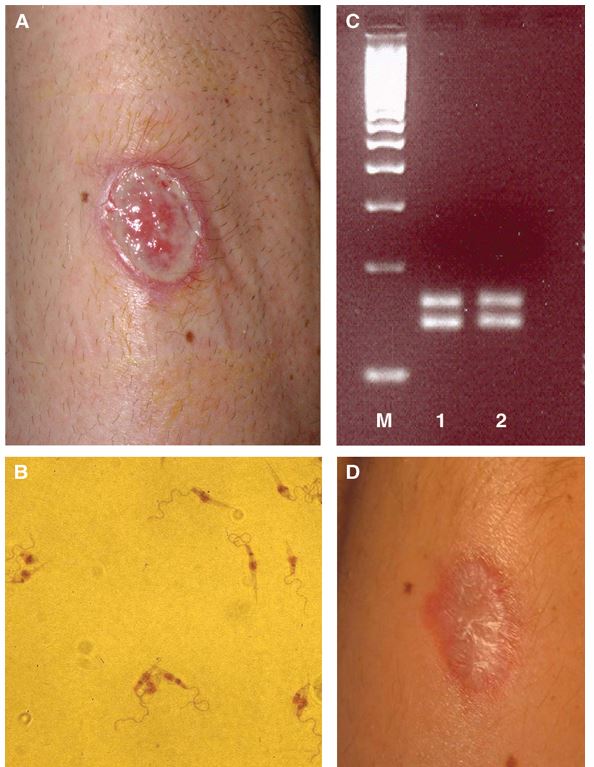
A: Non-healing New World cutaneous leishmaniasis ulcer on the left forearm.

B: Metacyclic Leishmania promastigotes in culture medium, Day 7.The parasites have a characteristic coiled, highly motile flagellum at the apical end of an elongated body (10–20 mm in length) containing a round nucleus and rod-shaped kinetoplast.

C: Molecular banding pattern in agarose gel after PCR analysis. The banding pattern resulting from restriction fragment length polymorphism PCR analysis was consistent with Leishmania braziliensis DNA (M: a commercial 100-base-pair molecular marker [EZ Load 100 bp molecular ruler; Bio-Rad Laboratories, Hercules, Calif, USA]; 1: L. braziliensis control strain; 2: patient sample).

D: Healed ulcer, 4 weeks after treatment with amphotericin B.

Posted in Module - Parasitology, Nepal, Parasitology, Presentations | Tagged | Leave a comment