Plasmodium species (malaria)

Recent CPHL malaria workshop materials – make sure you have a copy and review same.

Short answer questions to guide your further reading: 

  1. What rapid diagnostic tests are in use and what is their performance?  Check the kit inserts and share what you find please.  Also visit WHO Malaria RDT resource page.
  2. What are the PNG-specific current malaria treatment guidelines? (not necessarily what is in the old STG)
  3. What are the expected changes to be found on fbc and film examination of a patient with malaria?
  4. Describe artemisinin resistance – incidence and impact – see this WHO page.
  5. Describe current progress towards malaria vaccines – yes! there is a candidate vaccine that works to prevent malaria in children – pilot implementation project in three countries at present.

Scan Pubmed to browse recent research on malaria published by PNG projects.  Select a paper for your next journal club!

Posted in Module - Parasitology, Parasitology | Tagged | Leave a comment

Infection control guidelines – Pacific Nations

PPHSN Infection Prevention and  Control Guidelines –  2010 

These are likely to be updated before too long.  They are produced by PICNet – Pacific regional Infection Control Network.

Updated PNG Infection Control Guidelines are expected soon.

Posted in Infection prev & control, Pacific Island nations | Tagged | Leave a comment

Hepatitis E- more important issues for Pacific nations

Please see this previously posted presentation from Prof. Josh Davis about HEV– an excellent overview – tells the Australian part of the story – endemicity in pigs (genotype 3) and local foodborne outbreaks.  2022 reference (WHO) 

The only survey of seroprevalence in the Pacific was published in 2014, referencing data acquired from Kiribati, PNG and Fiji 2003-5 – essential reading.  Overall 15% seroprevalence in PNG, higher in the highlands.  It references some data showing that genotype 3 has been found in pigs in New Caledonia.

As discussed, there will be an unknown morbidity occurring in PNG, especially in pregnant women and it is almost certain that a large zoonotic reservoir exists. Ripe for some proper research and important that local testing is established. 

A recombinant effective vaccine to prevent hepatitis E virus infection has been developed and is licensed in China (Hecolin), but is not yet available elsewhere.

Posted in Med Micro topics-advanced, Module-virology | Tagged | Leave a comment

“UTI” – Requiem for a Heavyweight – a landmark paper

A really important paper to consider closely – i will send on a PDF via email as general access not available.  This editorial from the BMJ is a worthwhile read as well.

mdjkf's avatarAIMED - Let's talk about antibiotics

A recent paper, “Urinary Tract Infection”-Requiem for a Heavyweight  by Dr Thomas Finucaine skillfully unpacks many key issues, coupling this with a consideration of the emerging knowledge of the urinary microbiome and virome, suggesting that the term “UTI” might better be referred to as a “urinary dysbiosis”.  The paper is worth a detailed read – here is the start of the abstract –

“Urinary tract infection” (“UTI”) is an ambiguous, expansive, overused diagnosis that can lead to marked, harmful antibiotic overtreatment. “Significant bacteriuria,” central to most definitions of “UTI,” has little significance in identifying individuals who will benefit from treatment. “Urinary symptoms” are similarly uninformative. Neither criterion is well defined. Bacteriuria and symptoms remit and recur spontaneously. Treatment is standard for acute uncomplicated cystitis and common for asymptomatic bacteriuria, but definite benefits are few. Treatment for “UTI” in older adults with delirium and bacteriuria is widespread but no evidence supports…

View original post 474 more words

Posted in Module-Urinary tract infection | Tagged , , | Leave a comment

You are what you eat – or should our gut microbiome be considered an important body system in its own right?

mdjkf's avatarAIMED - Let's talk about antibiotics

Guest posting: Assoc. Prof. Josh Davis,  Principal Research Fellow/NHMRC Career Development Fellow, Menzies School of Health Research, Senior Staff Specialist Infectious Diseases Physician, John Hunter Hospital, Conjoint Professor School of Medicine and Public Health, University of Newcastle

The diverse bacterial communities which live in our gastrointestinal tract (primary in the colon), are collectively known as the “gut microbiota” and their collective genes are termed the “microbiome“.  A majority of the bacterial species cannot cultivated and require direct molecular techniques to ennumerate them.  Consideration of the microbiome is extremely topical in many fields of health-related research. At the recent major annual meeting of the American Society for Microbiology (ASM Microbe), the gut microbiome had its own stream (no pun intended – and the colour coding wasn’t brown) within the conference program, containing scores of research presentations in this field. In fact, one conference delegate, science writer and microbiologist Ed Yong, insisted…

View original post 364 more words

Posted in Conference report, Module-basic microbiology and AMR | Tagged | Leave a comment

Neisseria gonnorhoeae – testing overview

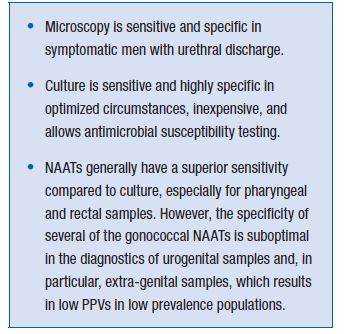
A Neisseria gonorrhoeae update from our registrar Ian Marr.  We still culture it regularly from our samples – susceptibility testing is done at a reference laboratory. PCR diagnosis from early pass urine is the mainstay for most patients (main test method for C. trachomatis as well).  The occurrence of multi-drug resistant gonnorhoea is an emerging concern.

SnipImage

Useful gono testing summary from WHO STI Lab manual: Pages from WHO STD LAB Manual

SnipImage

References

  • WHO STD Laboratory Reference Manual – this is a good reference to go to for advice on key techniques – see chapter 4
  • CDC USA Report on drug-resistant Ng. April 2018
  • P N G Med J. 2010 Mar-Jun;53(1-2):15-20.  Neisseria gonorrhoeae isolates from four centres in Papua New Guinea remain susceptible to amoxycillin-clavulanate therapy.  Toliman PJ1, Lupiwa T, Law GJ, Reeder JC, Siba PM.

    Antibiotic-resistant strains of Neisseria gonorrhoeae have the potential to undermine treatment and control of gonorrhoea, which remains a highly prevalent sexually transmitted infection (STI) in Papua New Guinea (PNG). The standard treatment regimen for gonorrhoea in PNG based on amoxycillin and clavulanic acid (amoxycillin-clavulanate) was introduced about 15 years ago and there is some concern that over time circulating strains may have developed resistance to this therapy. To investigate this, N. gonorrhoeae isolates (n = 52) were collected from STI clinics in geographically representative centres in PNG and tested for their in vitro susceptibility to a range of antibiotics. All 52 isolates tested were found susceptible to amoxycillin-clavulanate, despite 40% (n = 21) being penicillinase producers and thus resistant to penicillin. These findings indicate that amoxycillin-clavulanate therapy remains an effective treatment for gonococcal infections in PNG, and support the maintenance of the present standard treatment for gonorrhoea in PNG.

Posted in Module - STIs | Tagged | 1 Comment

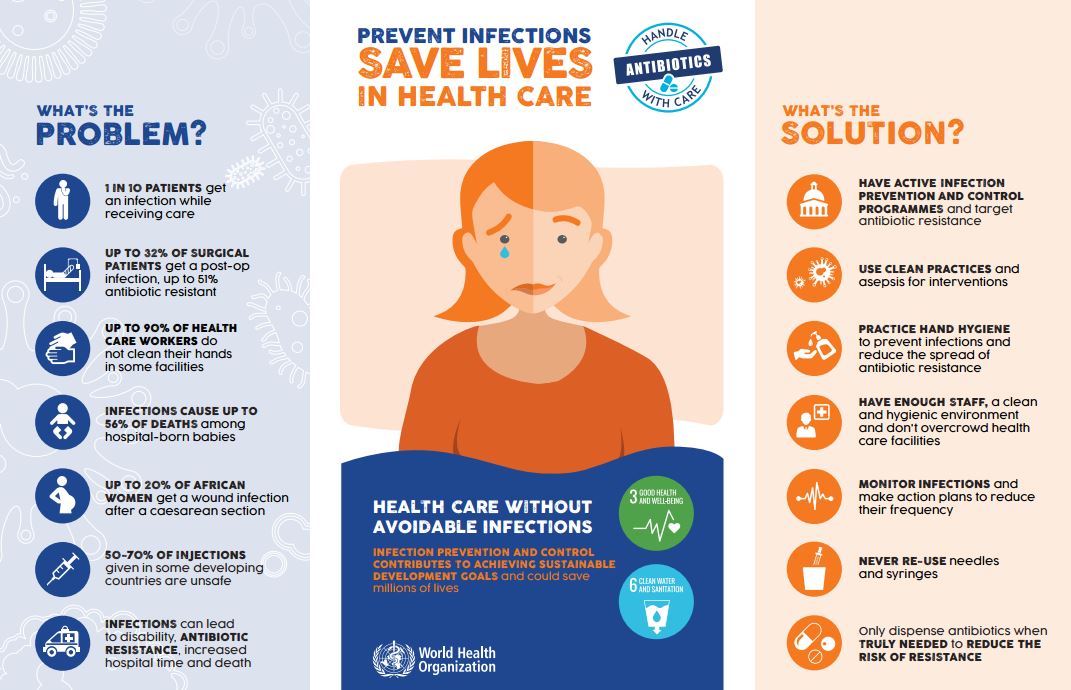
WHO Core Components for Infection Control

Essential guidelines published last year by the WHO.  There is an excellent brief (2 minute) video review of the components. This is the single page info graphic:

Remember also to complete the 10 free Australian Commission on Safety and Quality in Healthcare short online learning modules for Infection Prevention and Control. Enroll here!

Posted in Infection prev & control | Tagged , , , | Leave a comment

Q fever and other rickettsia

This Q fever presentation from Professor Stephen Graves is worthwhile of review.  The presence of Q fever in PNG is likely but not proven as yet.   Dr Ak’s paper to be appended soon!

Also review this summary of laboratory diagnosis of rickettsial infection from Prof Graves.


Posted in Med Micro topics-advanced | Tagged | Leave a comment

Module 6: Central nervous system infections- case studies and references

  1. Acute meningitides – CNS infection cases Ferguson 2017 acute

2. Chronic meningitis and encephalitis  –  Encephalitis and chronic meningitis Ferguson 2017

See also this posting concerning cryptococcal antigen detection for HIV patients.

Potential viva questions (practice with each other!):

  • What are the causes of acute meningitis in adults … in children  … in neonates
  • What are the typical CSF findings in viral m … bacterial m.
  • What is a parameningeal focus and explain what CSF findings might be expected
  • Interpret this CSF picture – e.g one of the cases above
  • Discuss the laboratory diagnosis of cryptococcal meningitis
  • Discuss the lab dx of TB meningitis
  • What are viral envelopes made of ? Contrast the properties of enveloped and non-enveloped viruses.
  • Describe the causes of chronic meningitis
Posted in Infectious diseases, Module-CNS infections | Tagged , , | Leave a comment

UPNG May revision M Med sessions – presentations and further references

2nd May 2017

  1. UPNG Infection prevention and control including TB IC Ferguson– presentation

2.  UPNG 2 AMR including Bacterial genetics Ferguson  –  presentation

These two posting from our sister blog may help with understanding antibiotic classes:

3rd and 4th May

3. UPNG 3 Antibiotic usage and practical AMS Ferguson –  presentation

Example management approach to Staphylococcus aureus BSI – n.b. 60 events at PMGH in 2016 (40% MRSA)

Potential M Med projects list relating to the national AMR plan (discuss with your supervisors) : Potential projects!

Local antimicrobial resistance studies:

Osteomyelitis

  • Management of bone and joint infections due to Staphylococcus aureus. Davis-JS. Intern Med J. 2005 Dec;35 Suppl 2:S79-96.  An authoritative review.  Contact me if a copy required. 
  • Antibiotics for treating chronic bone infection in adults – Cochrane systematic review 2013:  poor quantity and quality of evidence; no evidence for IV superiority over oral. Old studies.

Posted in A/m resistance, Infection prev & control, Med Micro topics-advanced, PNG | 1 Comment